Why Closet Doors Won’t Close — and the Depth That Fixes It
Posted April 23, 2026
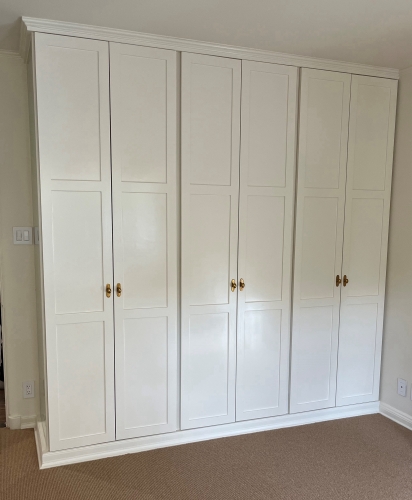
If your closet doors won’t close cleanly — you can hear the brush of fabric every time, you’ve had to leave the doors slightly open, or coats are getting visibly creased where the door pinches them — the problem isn’t the doors. It’s the closet’s depth.
This is one of the most-misdiagnosed problems in residential closet design. People blame their hangers, their doors, their clothes. The actual culprit is the geometry of how a hanging garment occupies space — and there’s a specific number that fixes it. Let’s walk through what’s really happening, and the only depth where doors actually close over all hanging clothes.
The Hanging-Clothes Problem
A hanging garment doesn’t hang flat against a hang bar — the hanger and shoulders push the garment outward by 4–6 inches before the rest of the clothing drops down. So a typical hanging shirt occupies roughly 22 inches front-to-back:
- ~12 inches from the back wall to the hang bar (where the rod sits)
- ~10 inches forward from the bar to the front of the garment’s shoulder/sleeve area
That 22″ is what your closet depth has to clear if you want a door to close cleanly in front of the garment. Most residential closets are framed at 24″ deep at the back wall — which sounds like enough until you account for the door frame, jamb, and the door itself, which often eat 2–4″ off the front. The result: your closet is functionally 20–22″ deep, just barely (or not quite) enough.
Why Most Closets Fail at Depth
If your hanging clothes brush the door, it’s usually one of three things:
- Standard closet depth, deep garments — A 24″-framed closet with a winter coat, suit jacket, or thick wool sweater on a thick hanger. The garment occupies more than 22″ and there’s no margin.
- Shelf-depth closet system installed at the back — If you have a 15″ or 18″ deep system installed against the back wall, hanging clothes overhang the front of the frame by 5″ (at 15″) or 2″ (at 18″). That overhang lands right where the door wants to close.
- Door swing or sliding mechanism eats clearance — Bifold doors with thick hinges, sliding doors with track depth, or French doors with frame thickness all reduce effective clearance by 1–3″.
The Three-Inch Rule
Here’s the rule professional closet designers use: doors close cleanly over hanging clothes only when the closet system is at least as deep as the garment. A typical garment is 22″ deep, and the closet door reduces effective space by ~2″, so the closet system needs to be at least 24″ deep to absorb the difference. Anything shallower means clothes will overhang the frame and contact the door.
This is why every freestanding wardrobe ever made is around 24 inches deep — the doors-need-to-close geometry has been the same since wardrobes existed.
The Only Depth Where Doors Always Work: 24″
At 24″ depth, hanging clothes fit fully behind the front edge of the closet system. The garment’s 22″ envelope sits inside the 24″ frame with a couple inches to spare — enough room for the door to close cleanly on every hanging item, regardless of garment type or thickness.
This is why 24″ deep closet systems are specifically built for closets and wardrobes with doors. It’s the only depth where doors close cleanly over all hanging garments — not just smaller items.
What 18″ Does (and Doesn’t Solve)
18″ sits in the middle. Hanging clothes stick out about 2″ past the front of an 18″ frame. That’s tight enough that doors can close in front of pants and smaller hanging garments — but suit jackets, dresses, and full-length coats may still brush the door.
Lundia 18″ depth offers a specific feature for closets in this in-between zone: a hang bar rail with a center hanging position. Standard hang bars sit at the back of the frame; the center-position rail moves the hang point inward, tucking clothes further behind the front edge so doors clear them. It’s the bridge between “15″, no doors over hanging” and “24″, doors over everything.”
What to Do If You’re Stuck With a Shallower Closet
If you can’t change your closet’s framed depth, three options:
- Skip doors over the hang area — Use 15″ depth (the most popular closet depth in the industry) and only put doors in front of shelving sections. Hanging clothes show, but the closet works.
- Use 18″ with center-position rails — Doors close over pants, shirts, and smaller items. Reserve dresses and suit jackets for an open section.
- Build out 24″ depth — If your wall has the room or you’re replacing a built-in entirely, 24″ depth solves the problem permanently. The closet system frame extends forward into the room rather than fitting against the back wall.
Most homes can accommodate 24″ depth in at least one bedroom wall. If you’ve been living with a closet door that won’t close, it might be time to stop fighting it. Send us your dimensions and we’ll design a fix for free.
Closet Doors and Depth — Frequently Asked Questions
Why don’t my closet doors close all the way?
Almost always because hanging clothes are sticking out past the front edge of the closet system, into the door’s closing path. Either the closet itself isn’t deep enough (most residential reach-ins are 24″ framed but only have ~20″ of effective depth after the door jamb), or the system inside the closet is shallower than 24″ and the clothes overhang it.
Will sliding doors fix the problem?
Sliding doors give you slightly more clearance than bifold doors (no swing arc), but they don’t solve the depth problem. If clothes still extend into the closet’s door track plane, sliding doors will catch them too. Track-mounted sliding doors typically need at least 22″ of effective depth.
Can I rebuild my closet to be deeper?
Yes — if there’s room behind the back wall or if you’re willing to build the closet out into the room. Many master bedroom closets get rebuilt at 30–36″ deep during renovations specifically to solve the door-clearance problem. Talk to us about your space.
What about a freestanding wardrobe?
Standalone wardrobes are typically 24″ deep precisely because that’s the depth where doors close cleanly over hanging clothes. A Lundia 24″ system can replace a freestanding wardrobe entirely — same depth, same closed-front look, with vastly more configurability. See 24″ deep closets and wardrobes.
Do all 24-inch closets have this door clearance?
At Lundia, yes — we engineer 24″ specifically so all hanging garments fit fully behind the front edge of the frame. Other manufacturers’ 24″ systems may vary; the key spec to check is frame depth measured from the back wall, not just the closet’s framing depth.
Doors not closing? We’ll design a fix.
Send us your closet’s dimensions and a description of the door problem — we’ll draft a 24″ (or appropriate-depth) solution for free, no obligation.
Get My Free DesignRelated reading:
← Back to Blog