Is your closet making you sick? 🧪
Posted on April 2, 2026
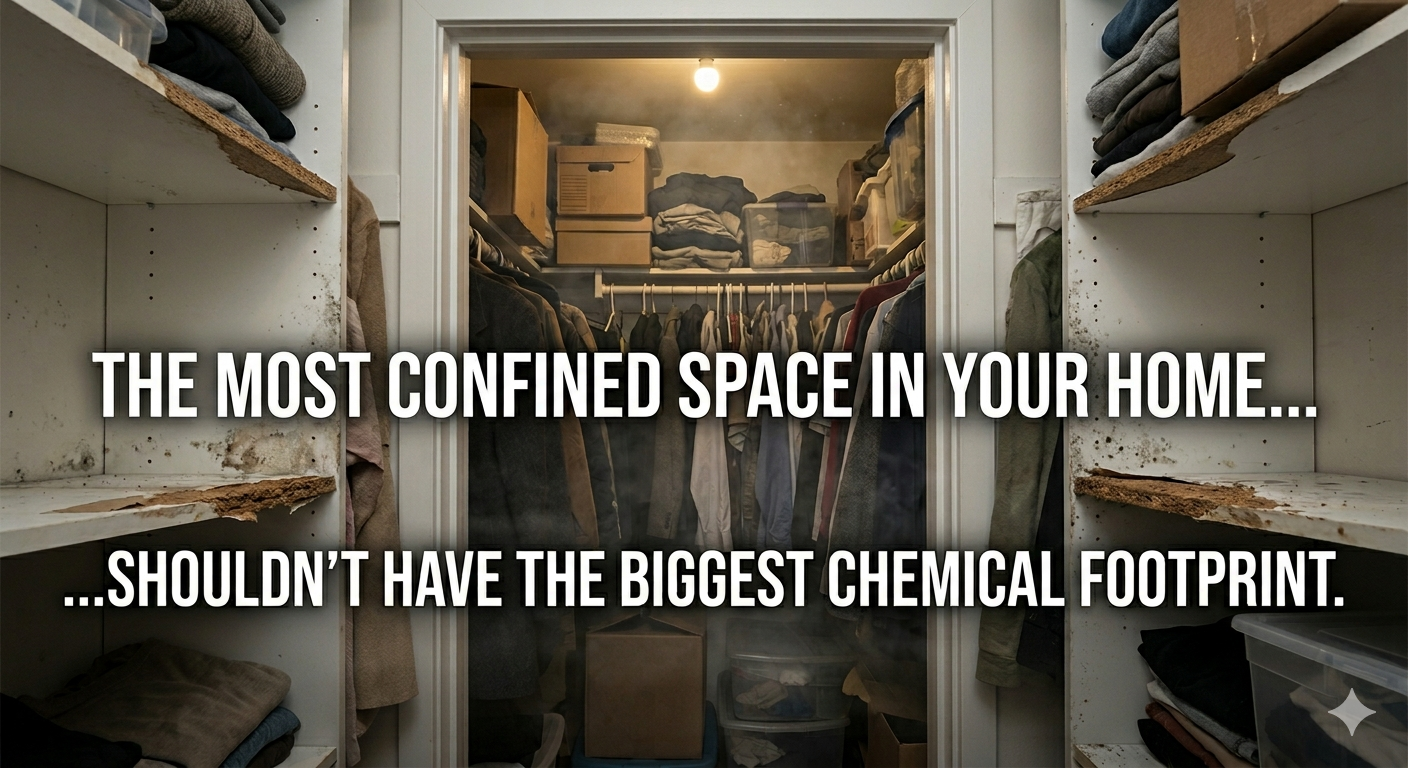
When we think of "air pollution," we usually picture smoggy cities or industrial factories. We rarely think of the most intimate, confined space in our homes: the closet.
For decades, the closet industry has shifted toward mass-produced "engineered wood"—a polite term for particle board. While it’s cheap and easy to ship, it comes with a hidden cost that goes far beyond a sagging shelf. In the tight, unventilated quarters of a closet, particle board can become a genuine health and safety hazard.
1. The Off-Gassing Trap
Particle board isn't grown; it’s manufactured. It’s made by pressure-bonding wood chips, sawdust, and shavings together using urea-formaldehyde resins. In a large, open living room, the "off-gassing" (the release of airborne chemicals) from one piece of furniture might dissipate. But in a closet—a small, enclosed space with zero airflow—those chemicals have nowhere to go. They saturate your clothes, your linens, and the very air you breathe while getting dressed.
The Formaldehyde Factor: Formaldehyde is a known respiratory irritant and a "known human carcinogen" according to the National Toxicology Program. In confined spaces, even "compliant" levels of formaldehyde can lead to watery eyes, headaches, and respiratory discomfort.
2. The Humidity & Mold Connection
Closets are notorious for poor circulation, which often leads to higher humidity levels. This is where particle board becomes a structural liability:
The Sponge Effect: Unlike solid wood, particle board is highly porous. When it absorbs moisture from the air, the glues begin to break down. The material swells, warps, and—most dangerously—becomes a breeding ground for mold and mildew.
Structural Failure: Once particle board absorbs moisture, it loses its "screw-holding" power. This is why those "big box" closet systems often pull away from the wall or collapse under the weight of a standard wardrobe.
3. Impact on the Most Vulnerable
If you are designing a nursery closet or a space for someone with asthma or allergies, the material choice is critical. Children are more sensitive to Volatile Organic Compounds (VOCs) because they breathe more air relative to their body weight than adults do.
Choosing a solid wood system isn't just an aesthetic choice; it’s a decision to keep the "chemical footprint" of your child's room as close to zero as possible.
4. The Lundia Difference: Why Solid Wood Wins
At Lundia USA, we believe your home should be a sanctuary, not a source of chemical exposure. By using 100% solid wood manufactured right here in the U.S., we eliminate the need for toxic resins and glues.
Naturally Breathable: Solid wood handles fluctuations in humidity without swelling or off-gassing.
Lifetime Durability: While particle board systems are destined for a landfill in 5–10 years, a solid wood closet is a permanent investment in your home’s value and your family’s health.
Peace of Mind: You can hang your clothes in a Lundia closet knowing that the only thing "off-gassing" is the faint, natural scent of real wood.
Summary: Ask Before You Buy
The next time you’re looking at a closet "system," don't just look at the price tag. Ask what’s inside the boards. If it’s sawdust and glue, it doesn’t belong in your home’s most confined spaces.
Choose Solid Wood. Choose Lundia USA.
Particle board is made of thousands of small wood chunks glued together with formaldehyde resin. It's is the least expensive material for making wood products. Particle Board is the core panel that is used for melamine and mdf closets